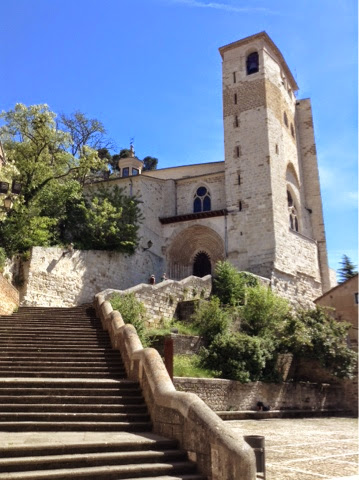
| Luke 6:17-19 says: "And he came down with them and stood on a stretch of level ground. A great crowd of his disciples and a large number of the people from all Judea and Jerusalem and the coastal region of Tyre and Sidon came to hear him and to be healed of their diseases; and even those who were tormented by unclean spirits were cured. Everyone in the crowd sought to touch him because power came forth from him and healed them all." The walk continues to be a beautiful and challenging experience. The people one meets along the way are kind and helpful. I've met people from France, Mexico, Gremany, Italy, Korea, and the USA . All are walking for various reasons but I believe all of us are searching for deeper and more intimate relationship with God. The weather has been better these past two days. No rain and plenty of sunshine. I walked most of the day by myself which allowed me the time to reflect and pray. I'm enjoying the walk tremendously but my feet don't agree. I've got blisters forming on the bottom of my feet which makes walking a little difficult and painful. I hope and prayer that they don't get any worse. Since I'm behind in my posting I don't have too much more to write about. I will conclude by sharing a few pictures with all of you. Please pray for my good Fr. Larry Klein who recently underwent surgery for a kidney transplant and for my other good friend, Mari Caballero, who will be having heart valve replacent surgery within a couple of weeks. God bless and heal them both as well as all the sick throughout the world.  |
         |
Sunday, May 4, 2014
Day 4 of the Camino - Dedicated to all the sick
Today I dedicated the walk and my prayers to the sick. Many people asked me to pray for their loved ones who are ill or that were undergoing some type of surgery. I also included the members of my family and good friends in this prayer as well. May all the sick throughout the world experience healing and peace through Christ.

Day 3 of the Camino dedicated to the Pope Francis, Bishop Flores, Bishop Peña, Priests, Deacons, Seminarians and Religious Women and Men who are serving in the Brownsville Diocese
I dedicated my day of walking and prayer for the intentions of Pope Francis, Bishop Flores, Bishop Peña, the priests and seminarians of the Brownsville Diocese as well as for all the women and men religious who serve in the Diocese.
We left our hotel in Pamplona around 9:20 a.m. We stopped off at a local church to begin the day with prayer. From there we walked through the city of Pamplona. I thought we would never reach the outskirts of the city. It seemed like an eternity (it was 1 hour). Walking on pavement and concrete is no fun when your feet & legs are hurting). We then headed up the first of 2 mountains. Yes, I said mountains! Climbing the mountains is not as difficult as the coming down. At the end of the day I wasn't sure if I was going to make it to our hotel. Only by the grace of God and the help of my walking sticks was I able to complete today's journey.
There's something good to say about those walking sticks. They have been a great help and support in climbing and descending the mountains. They have also kept me from stumbling over the ROCKY terrain. I've also used them to lean on in moments when we were idle. In many ways the have been the support and security that have helped me to walk the Camino thus far.
As I reflected more upon the use of these two sticks and the support they have provided, I began to realize that these "two sticks" have been a part of my journey since the moment I was conceived.
As I see it, God has provided me with "walking sticks" throughout my life. The "walking sticks" I'm refering to are the many wonderful people (family, friends, etc.) that God has placed in my path who have been a source of love, strength and encouragement. They are the people who support me and also allow me to lean on them in time of need. They help me to walk in love and try and keep me from stumbling. They all have truly been a godsend.
There is a story in Exodus 17:8-13 where Moses tells Joshua to take certain men from among the Israelites and to go out and engage the Amalek's in battle. Joshua does what Moses asks of him while Moses went to the top of the hill with Aaron and Hur. As long Moses kept his hands up in the air, the Israelites were winning the battle. Whenever he let his arms down, the Amalek's began to win. Moses' arms grew tired so Aaron and Hur put a rock in place for Moses to sit on and then the two of them kept Moses hands up in the air until sunset at which time Joshua won the battle. Without Aaron and Hur's help Moses would not have been able to keep his hands up in the air and the Israelites would have lost the battle. The point of the story is that we all need help and as a community of faith we are all called to reach out to others and become their "walking sticks."
Who are the "walking sticks" in your life? Have you thanked God today for these special people?
The "Walking Sticks"


The Camino to Santiago.

More of the Camino.

One of many grape vineyards along the way.

One of any wheat fields.

Metal sculptures of pilgrims.

Bales of hay.

Friday, May 2, 2014
Day 2 of the Camino - dedicated to my family
Today was the second day of the Camino. We walked 14 miles. Needless to say I am tired and sore. The weather was a mixture of rain and sunshine but we were blessed with the sight of another rainbow (we had a rainbow on the first day as well). The path was muddy and difficult. I can't help but think that life can be like that, muddy and difficult. The important thing to remember in these moments is that God walks life's journey with us and we are never alone. No matter how messy or difficult life can become, we must never lose hope! Sometimes we have to walk through the mud and the muck before we can experience the beauty of the rainbow.
 Hotel in Askerreta where we stayed last night. This is one of the hotels that appears in the movie, "The Way." Remember the scene from the movie where the Canadian woman calls Martin Sheen who plays the role of Tom, "Boomer"? This is the hotel where that scene takes place.
 Another picture of the hotel.
 One of the many markers along the way that informs the pilgrim of the Camino path.
 A beautiful site!


Thursday, May 1, 2014
What is the Camino to Santiago
Long Description written by UNESCO
Pilgrimages were an essential part of western European spiritual and cultural life in the Middle Ages and the routes that they took were equipped with facilities for the spiritual and physical well-being of pilgrims. The Route of St James of Compostela has preserved the most complete material record in the form of ecclesiastical and secular buildings, settlements both large and small, and civil engineering structures. This Route played a fundamental role in facilitating the two-way interchange of cultural developments between the Iberian Peninsula and the rest of Europe during the Middle Ages. There is no comparable Christian pilgrimage route of such extent and continuity anywhere in Europe: the other two pilgrimage routes, to Jerusalem and Rome, are only recognizable in a very fragmentary fashion. In addition to its enormous historical and spiritual value, it also represents a remarkably complete cross-section of European artistic and architectural evolution over several centuries.
The different pilgrimage routes converged on Santiago de Compostela, at the foot of the Apostle's tomb, and were lined with works of art and architectural creations. The cultural heritage scattered along the length of these routes is immensely rich. It represents the birth of Romanesque art; then came the Gothic cathedrals and the chains of monasteries.
The tradition whereby the Apostle St James the Great preached the Gospel in Spain dates from the early 7th century. In the Latin Breviary of the Apostles, St Jerome held that apostles were buried where they preached, and so it was assumed that the body of St James had been moved from Jerusalem, where according to the Acts of the Apostles he was martyred on the order of Herod Agrippa, to a final resting place in Spain. It was not until the 9th century that the apostle's tomb was identified at Compostela. The late 8th century saw the consolidation of the Christian kingdom of Galicia and Asturias in northern Spain, with the support of Charlemagne. It was to provide the base for the reconquest of the peninsula from Muslim domination, a process that was not to be completed until 1492. The apostle had been adopted as its patron saint by the Christian kingdom against the menace of Islam, and in the early years of the 9th century, during the reign of Alfonso II, his tomb was 'discovered' in a small shrine by the hermit Pelayo and Todemiro, bishop of the most westerly diocese in the kingdom.
The fame of the tomb of St James quickly spread across western Europe and it became a place of pilgrimage. By the beginning of the 10th century pilgrims were coming to Spain on the French routes from Tours, Limoges, and Le Puy, and facilities for their bodily and spiritual welfare began to be endowed along what gradually became recognized as the formal pilgrimage route, while in Compostela itself a magnificent new basilica was built to house the relics of the Apostle, along with other installations - churches, chapels, hospices and hospitals. The 12th century saw the route achieve its greatest influence, used by thousands of pilgrims from all over Western Europe. In 1139 the first 'guidebook' to the Route appeared, in the form of Book V of the Calixtine Codex (attributed to Pope Calixtus II but most probably the work of the pilgrim Aymeric Picaud), describing its precise alignment from Roncesvalles to Santiago de Compostela and listing the facilities available to pilgrims. These structures, ranging from humble chapels and hospices to magnificent cathedrals, represent every aspect of artistic and architectural evolution from Romanesque to Baroque and beyond, demonstrating the intimate linkages between faith and culture in the Middle Ages.
There are two access routes into Spain from France, entering at Roncesvalles (Valcarlos Pass) and Canfranc (Somport Pass) respectively; they merge west of Pamplona, just before Puente la Reina. It passes through five Comunidades Autónomas and 166 towns and villages, and it includes over 1,800 buildings of historic interest; in many cases the modern road runs parallel to the ancient route. The tradition of pilgrimage to Santiago has not ceased since that time, although its popularity waned in recent centuries. Since it was declared to be the first European Cultural Itinerary by the Council of Europe in 1987, however, it has resumed the spiritual role that it played in the Middle Ages, and every year sees many thousands of pilgrims following it on foot or bicycle.
Historical Description
The tradition whereby the apostle St James the Great preached the gospel in Spain dates from the early 7th century, in the Latin Breviary of the Apostles. St Jerome held that apostles were buried where they preached, and so it was assumed that the body of St James had been moved from Jerusalem, where according to the Acts of the Apostles, he was martyred on the order of Herod Agrippa, to a final resting place in Spain.
It was not until the 9th century that the apostle's tomb was identified at Compostela. The late 8th century saw the consolidation of the Christian kingdom of Galicia and Asturias in northern Spain, with the support of Charlemagne. It was to provide the base for the reconquest of the peninsula from Muslim domination, a process that was not to be completed until 1492. The apostle had been adopted as its patron saint by the Christian kingdom, and in the early years of the 9th century, during the reign of Alfonso II, his tomb was "discovered" in a small shrine by the hermit Pelayo and Todemiro, Bishop of the most westerly diocese in the kingdom.
The fame of the tomb of St James, protector of Christendom against the menace of Islam, quickly spread across western Europe and it became a place of pilgrimage, comparable with Jerusalem and Rome. By the beginning of the 10th century pilgrims were coming to Spain on the French routes from Tours, Limoges, and Le Puy, and facilities for their bodily and spiritual welfare began to be endowed along what gradually became recognized as the formal pilgrimage route, whilst in Compostela itself a magnificent new basilica was built to house the relics of the apostle, along with other installations - churches, chapels, hospices, and hospitals. The 12th century saw the Route achieve its greatest influence, used by thousands of pilgrims from all over Western Europe. In 1139 the first "guidebook" to the Route appeared, in the form of Book V of the Calixtine Codex (attributed to Pope Calixtus II but most probably the work of the pilgrim Ayrneric Picaud), describing its precise alignment from Roncesvalles to Santiago de Compostela and listing the facilities available to pilgrims. These structures, ranging from humble chapels and hospices to magnificent cathedrals, represent every aspect of artistic and architectural evolution from Romanesque to Baroque and beyond, demonstrating the intimate linkages between faith and culture in the Middle Ages. The establishment of the pilgrimage route inevitably led to its adoption as a commercial route, resulting in economic prosperity for several of the towns along its length.
The tradition of pilgrimage to Santiago has not ceased since that time, though its popularity waned in recent centuries. Since it was declared to be the first European Cultural Itinerary by the Council of Europe in 1987, however, it has resumed the spiritual role that it played in the Middle Ages, and every year sees many thousands of pilgrims following it on foot or bicycle.
Two Days before the Camino
I've just left Rome in route for Madrid. The Camino starts on Thursday, May 1st. I'm know I'm not physically fit for this walk but it's something that I've wanted to do since I first visited Compostela. I expect to encounter on this walk moments of joy, laughter, solitude, peace, prayer, beauty, new insight, tiredness, refreshment, and frustration. I pray that I am open to all that God wants to share with me and that I learn and grow from the experience.
I will be sharing the beginning of this journey with my good friend Fr. Benjamin, my sister Janice and her husband Peter and along the way will be joined by another good friend, Sr. Leota, of whom I've known since I was in High School. I look forward to sharing Eucharist & our faith together as we all seek the intercession of St. James to draw us closer and more intimately to our God.
"Change is inevitable. Growth is optional"
Day 1 of the Camino

Fr. Benjamin


The Camino


Day before the Camino
Applying for the Camino Passport


Blessing of the Pilgrims at Mass


Altar at St. James Church
Statue of St. James at the Church of St. James in Roncesvalles, Sp
Subscribe to:
Posts (Atom)